A place for reverie.
Reverie is the analyst Wilfred Bion's name for daydreaming on another's behalf: receiving what is still unspoken, even unspeakable, and slowly helping it become thinkable. It's the heart of how I work. In time, it becomes something you carry: for yourself, and for the people you love.
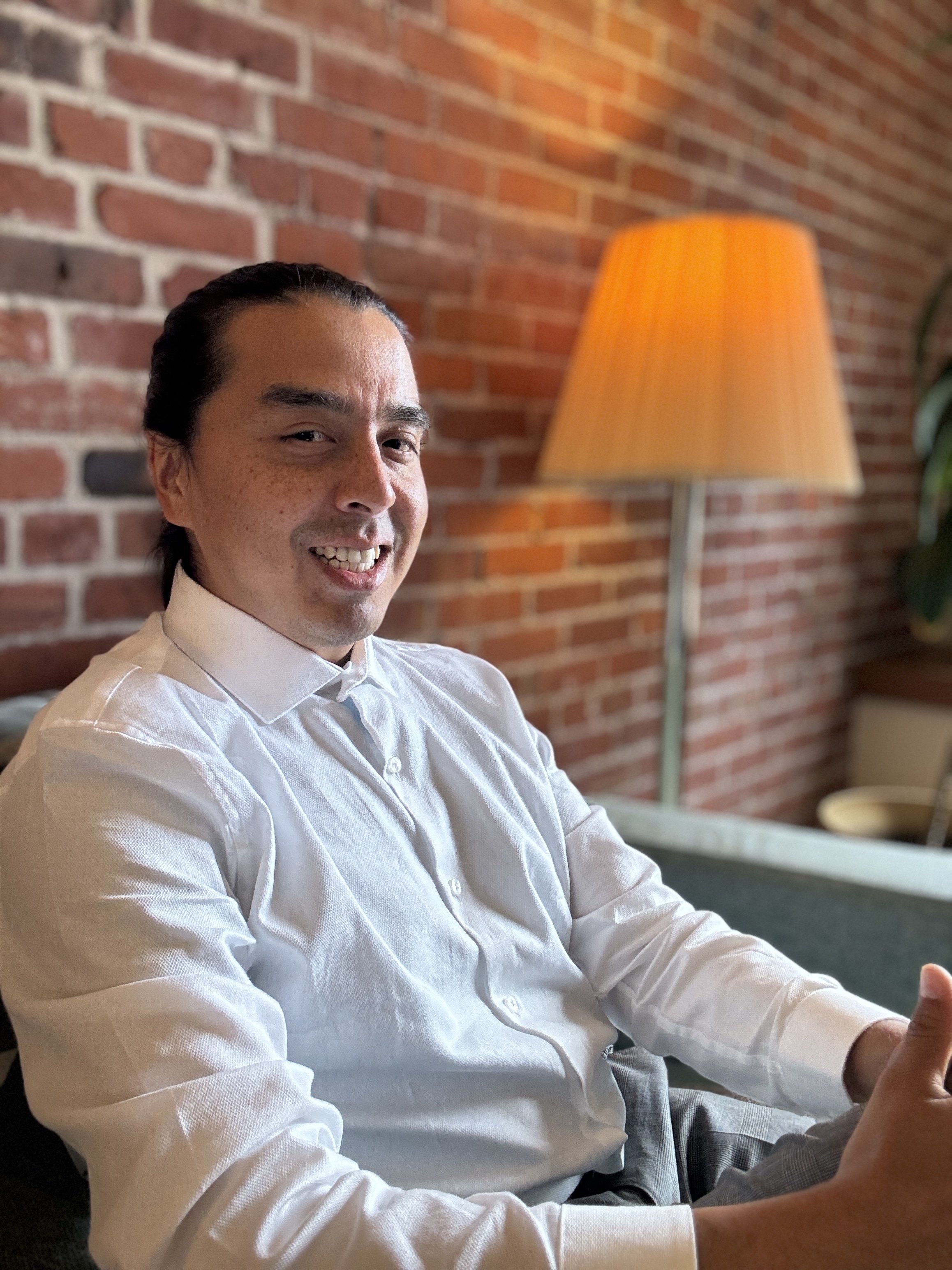
I'm Carlos Encalada, a licensed clinical social worker, psychoanalytic psychotherapist, and psychoanalyst in training. I work with adults, couples, children, and families, in English y en español.
How I work
Some emotions and experiences are hard to speak, see, and feel. Deep listening means getting involved in how life is right now, and how it has always been, or felt. I really want to know how you experience your life.
My approach draws on psychodynamics, attachment, and your history of developmental and experiential trauma, alongside your culture, identity, and childhood. The process can be vulnerable, frustrating, and liberating. Connection, acceptance, and empathy bring peace of mind.
My psychoanalytic curiosity often turns to the impact of early, pre-verbal life disturbances, helping you connect your suffering to challenging body experiences or intense life events. Hard-to-describe struggles in relationships, cultural identity, career, or life transitions can bring up conflicts from the past.
Therapy is an intimate, organic process that takes time. We usually begin weekly and adjust as we learn what you need. If you're new to this, I encourage you to meet several therapists and find the connection that feels right.
Common concerns I work with: anxiety · depression · trauma · ADHD & neurodivergence · relationship issues & family conflict · racial & cultural identity · life transitions · LGBTQ+ · caregivers · chronic pain · addiction. I also offer consultation for psychotherapists and for those already in therapy.
Is this you?
The problem-solver
An engineer, a techie, capable of untangling complex systems. Yet some emotions and relationships resist being solved. You've maybe even asked the chatbots. Some things need a person.
The creative
An artist or writer who works by intuition and vision. Yet sometimes intuition leads in circles, or toward work you aren't passionate about.
The caregiver
A healer, parent, or confidant whose presence soothes others. Your greatest strength can be your greatest challenge: caring for yourself.
The one in-between
Cross-cultural, interdisciplinary, a translator between worlds. Seeing every perspective sometimes costs more energy than it gives back.
The injured worker
An injury on the job takes more than your health: your trade, your routine, your sense of worth. I have years of experience supporting patients through open workers'-compensation cases, in English y en español.
About me
I'm a fully licensed clinical social worker (NY, NJ, PA, WA), currently a candidate in the Adult and Child & Adolescent analytic training programs at IPTAR in New York. I've worked in clinical social services since 2010, over fifteen years, first in Seattle and now in New York.
For four years I worked as a bilingual community mental-health therapist at Consejo Counseling, then a King County regional support network, where I earned Washington State specialization designations in Ethnic Minority Mental Health (Latino population) and Child Mental Health and completed Trauma-Focused CBT training. For several more years I was a Spanish-speaking psychotherapist for caregivers and injured workers in workers'-compensation cases; I have worked with Latino patients in Spanish since 2014. Most of my work has been with adults in a psychoanalytic frame, in person and via telehealth; I'm expanding my practice to children, couples, and families.
Before psychotherapy, I studied Computer Science at MIT, served in the Peace Corps in the Dominican Republic, and worked as a professional editor at the University of Chicago. I received my MSW from Smith College School for Social Work in 2012, and recently trained in coding the Adult Attachment Interview.
I've lived abroad in England and the Dominican Republic, and my family is from South America: Colombia and Ecuador, to be specific. These experiences shape how I listen across cultures, languages, and ways of living.
"In the time I have known Carlos, he has consistently demonstrated deep care and unwavering commitment to the people he works with. His passion for the work is not just a professional quality; it permeates every aspect of his life."
— Ryan Miller, MSW, LICSW
En español
Soy trabajador social clínico con licencia completa en Nueva York, Nueva Jersey, Pensilvania y Washington, y candidato en los programas de formación analítica de adultos y niños en IPTAR. Trabajé cuatro años como terapeuta bilingüe en salud mental comunitaria y llevo más de quince años en los servicios sociales clínicos, primero en Seattle y ahora en Nueva York.
En el psicoanálisis, la rêverie, la ensoñación, es la capacidad de soñar despierto en beneficio del otro: recibir lo que aún no se puede decir y ayudarlo, poco a poco, a volverse pensable. Este es el corazón de mi trabajo. Ofrezco psicoterapia en español, en persona en Manhattan y por telesalud. Mi familia es de Sudamérica, de Colombia y Ecuador. Aquí todos somos bienvenidos.
Fees & logistics
Sessions
$250 per individual session. A sliding scale is available: what you can afford, based on therapeutic need and financial circumstances, is a worthwhile conversation to have with me.
Insurance
I accept NY Workers' Compensation Board and WA L&I workers'-compensation cases. Otherwise I am out of network, and I can provide a superbill (medical receipt) that helps with out-of-network reimbursement.
Location & hours
230 West 13th Street (West Village). Tuesdays 7am–2pm, Thursdays 2pm–8pm, and Fridays 7am–8pm. Telehealth available in NY, NJ, PA, and WA.
Payment
Cash, check, or Zelle.
Common questions
What is psychoanalytic and psychodynamic therapy, and how is it different from CBT?
Psychoanalytic and psychodynamic therapy considers the patterns that happen that often are outside of our conscious awareness. Rather than focusing on our ideas, thoughts, cognitions of our lives and teaching techniques to manage symptoms, we try to understand what those symptoms are expressing and where they come from. It tends to be more open-ended and can be experienced as depth-oriented since it often draws from our oldest experiences of our lives rather than recent short-term, skills-based approaches like CBT which draw upon our ideas about our lives. Many people come to this work because quicker fixes haven't reached what actually troubles them.
Is psychoanalytic and psychodynamic therapy evidence-based?
Yes. Psychodynamic psychotherapy has been studied in controlled trials and meta-analyses, and it performs about as well as other established treatments, including CBT, with gains that tend to hold or even grow after therapy ends. Two honest qualifications, though. The strongest evidence is for time-limited, weekly psychodynamic therapy; for intensive, long-term analysis specifically, the controlled research is thinner and still developing. And the research does not show that any single approach is right for a particular type of person: fit, your own engagement, and the relationship between us predict outcomes more reliably than the name of the method. That is why I encourage anyone new to therapy to meet a few clinicians and choose the connection that feels right, rather than the label.
Sources: Steinert et al., Am J Psychiatry, 2017 · Abbass et al., Cochrane Database Syst Rev, 2014
Is a Licensed Clinical Social Worker (LCSW) the same as a psychologist?
No. They're different licenses. In New York, "psychologist" is a protected title held by clinicians with a doctorate in psychology. In New York, "psychoanalyst" is also a protected term; internationally, through the IPA, those who complete psychoanalytic training can be considered psychoanalysts. I'm a Licensed Clinical Social Worker (LCSW), trained to provide psychotherapy, and a candidate in psychoanalytic training at IPTAR, so someday I will hold the psychoanalyst title, but for now I am a psychoanalytic candidate. I do psychoanalytically informed psychotherapy, not psychological testing or neuropsychological evaluations; if you specifically need testing, I'm glad to point you toward a colleague.
Do you offer therapy in Spanish?
Yes. I'm bilingual and see patients in English y en español, in person and by telehealth. My family is from Colombia and Ecuador, and much of my work has been with Spanish-speaking patients, caregivers, and injured workers. Mi voz en español es diferente, pero mi conexión con su experiencia es una labor de mi corazón: nace de mi experiencia apoyando a personas de diferentes circunstancias y también de mi formación. Aquí todos somos bienvenidos.
Do you offer telehealth, and in which states?
Yes. I see patients in person in Manhattan's West Village and by secure telehealth anywhere in New York, New Jersey, Pennsylvania, and Washington, where I'm licensed.
How much does therapy cost, and do you take insurance?
Individual sessions are $250. I'm out of network with insurance, but I can provide a monthly superbill (a medical receipt) you can submit for out-of-network reimbursement. A sliding scale is available depending on need and circumstances. I do accept NY Workers' Compensation Board and Washington L&I workers'-compensation cases.
Do you work with workers'-compensation cases?
Yes. I have years of experience supporting people through open workers'-compensation claims, in English y en español, and I accept NY Workers' Compensation Board and Washington State L&I cases.
How often will we meet, and how long does therapy take?
We usually begin weekly and adjust as we learn what you need; some work benefits from meeting more than once a week. Depth-oriented therapy is an open-ended process rather than a fixed number of sessions. It takes the time it takes. If you're looking for brief, structured, short-term treatment, I'm happy to help you find a better fit.
How do I get started?
The simplest way to begin is a short email or phone call. Tell me you're looking for a consultation and a few times you're free, and we'll find a time to talk. New patients are welcome.
Take the leap
I see patients in person in Manhattan's West Village and by telehealth in NY, NJ, PA, and WA. New patients are welcome. Reach out and we'll find a time to talk.
The simplest way to begin is a short email or a phone call. Tell me you're looking for a consultation and a few times you're free, and we'll go from there.
A note on privacy: email is not a fully secure medium. Feel free to keep your first message brief; we can speak by phone.